About David B. Levy (PhD)
David B Levy [PhD 2000, MLS 1995] became a researcher, librarian, writer, and lecturer on YouTube. [1] He has produced more than 50 book publications, which can be found in the National Library of Israel library catalog. [2]
Early Life and Education
David graduated from Gilman high school magna cum laude where David received "the love of learning prize.".[3]
Education and Graduate Scholarship
Doctor of Philosophy (PhD)
Baltimore Hebrew University — Jewish Philosophy, Biblical Exogesis, and Jewish History and Rabbinics
As an autodidact, David developed his dissertation to cover a wide scope on Jewish Theodicy: radical evil, suffering, and catastrophe in Jewish History and the ethical implications of Rabbinic Theodicy.
Master of Library Science (MLS)
University of Maryland College Park
David tailor made his MLS degree to cover classification of library organizational systems, cataloging of Judeica and Hebraica, censorship of Jewish books, and Jewish Lexography, etc.
Bachelor of Arts (BA)
Liberal Arts, Philosophy, and Comparative Literature — Haverford College
Foundational education focused on classical philosophy, logic, and intellectual history. This rigorous program provided the critical conceptual tools necessary for subsequent specialized research in religious philosophy and the history of ideas. Two of David's favorite professors were Drs Richard Bernstein and Aryeh Kosman. For instance, with Richard Bernstein David learned Wittgenstein, Heidegger, Nietzsche, Kant in the original German. At the time, the English department required a MA level thesis. David wrote his thesis on the concept of negation, absence, and nothingness in Shakespeare work with an appendix analog of these concepts in philosophy from antiquity to the present.
Key Accomplishments


Doctoral Thesis Distinction
Scholarly Publication
Pedagogical Excellence
David has published over 55 books, hundreds of peer reviewed articles, and thousands of book reviews.
David has authored about 40 lectures on a host of topics related to Jewish studies, which he made publicly available on Youtube.
David was awarded the prize of Rosa and Gedaliah Cohn for Academic Excellence and the Sindy Breitbart prize in philosophy.
Publications
Below you can find a tincture of David's publications, covering topics like


Essays in the Philosophy and History of Science
This book has over 40 chapters on a diverse range of topics in the history of science including: (1)The social construction of Science, (2) Menachem Fish: Philosopher of Mathematics, (3) Technocracy: Wo die Gefahr ist wachste das Retende auch, (4) digital memory, (5) Rabbinic reception history of Copernicus' helliocentric universe and its religious implications, (6) Computer science and ontology, (7) Libraries in post-modern digital age, (8) Revolutions in Library science, (9) republished Review of medicine in the 19th century that appeared previously in the peer reviewed journal of The History of Medicine and the Allied Sciences, (10) Humanistic medicine, (11) James Reeves American Medical pioneer, (12) Moral ethical concerns of the online environment and privacy rights, (13) science and torah, (14) What is philosophy of science, (15) Cosmology and ma'aseh bereshit, (16) Pathological realities and history of immunization, (17) Music and Medicine, (18) Jewish alchemy and the Maharal, (19) Julius Friedenwald Historian of Jews in Medicine, (20) Oliver Sacks: Interdisciplinary nature of creative writing and neurology, (21) Sander Gilman, Michel Foucault, Ludwig Wittgenstien, Charlotte Perkins Gilman, and Anne Harrington critique of psychology as a fuzzy science with bias, (21) Thomas Kuhn's The Structure of Scientific Revolutions: Paradigm shits, (22) Leo Strauss defense of science against Nietzsche's critique of Cyclopic Socratic methed, (23) Athens (science) vs. Jerusalem (revealed religions), (24) ethics of ecological Environmentalism, (25) Linguistics, Mathematics, and Anthropological insights on the metaphysical concept of time, (26) Tobias Danzig' s Number the language of science, (27) Fractals- mysterious G-d encrypted patterns in Nature, (28) mathematics and music, (28) sudden death in the Bible and criteria of death in the Talmudim, (29) ethics and the internet, (30) Einstein's theory of relativity, (31) Rabbinic folk healer physicians in the Talmud, (32) Julius Preuss' Biblische und Talmudische Medizin, (33) Rif on Revolutions in zoom technology, (34) Epidemics in Biblical and Rabbinic history and Responsa, (35) Rambam's medical writings, (36) Rambam's understanding of Physics as a pre requisite to ma'aseh bereshit, and Metaphysics as a prerequisite to ma'aseh merkavah, (37) Why Rambam views Ben Zoma being "outside" in his study of logic and Rambam's first work Sefer HaHigayon (work in syllogism), (38) Rambam's medical writings (39) Essays in the enigmatic, esoteric, mystical intersection of science at the minds limits and Jewish mysticism, (40) Sefer Iyov and the history of science implicit in chapter 38,
Essays and Explorations in the Enigmatic, Esoteric, and Mystical based on sources in Rabbinic ad Fontes
The reviewer rabbi moshe weisblum reviewed the book in 5 pages and ends his review with the following: These two excellent volumes introduce the reader to a wonderous, awe inspiring, and at time ecstatic thrilling spellbinding, journey that begins at the Mind’s Limits and carries the soul even to realms beyond (Leila Leila) while at the same time being authentically highly relevant, germane, and timely . Time will tell which of Dr. Levy’s complete 13 volume set will serve as a signature piece for an author who makes the most urgent and fundamental subjects vividly come alive in an absorbing page turning read and study that is extremely emotionally deeply satisfying and deeply penetrating sounding the depths. These volumes usher the reader into an enchanted forest and deliver the pilgrim spiritual soul into a kind of cognitive clearing of mental sunrise upon further dawning mental sunrises. Like a deep sea diver the author of these volumes brings up from the ocean floor of consciousness previous gems of wisdom that will delight and refresh the mind in an age plagued by elitism. By an author who has no political agendas, axes to grind, or crass careerist ulterior motives of promotion, that is to say an author who writes not for careerist tenure and Macbethian career advancement, these volumes serve as an offering of a labor of love, a Kiddush ha-shem. The whole set is an offering worthy of the altar of merit, by an autodidact whose rare work is `an exception that makes all the exceptions' and defies all statistics, in an lemning age of conformity and sycophantism, plagued by Shakespearian Poloniuses, Sinclair Lewisian Babbitts, Thackery `Becky Sharpes' of Vanity Fair. To be ignored by the many only at risk.

David HaMelekh

Constellations of a Rabbinic Pantheon
David's book, Constellation of a Rabbinic Pantheon, offers historical sketches of major Gedolei ha dor during Geonim, Rishonim, and Ahronim periods accompanied with power point shots of how to research their rabbinic oeuvre online in databases like Otzar HaHokmah, Hebrewbooks.org, and Bar Ilan. Just some of the Rabbis include Rav Saadaia Gaon, Rashi, Rambam, Ramban, Ramhal, Rabbi Shimshon Raphael Hirsch, Rav Soloveitchik, Rav Kook, etc.

The Shoah as a Manifestation of Radical Evil; Book offers philosophic, rabbinic, and historical analysis of theodicy in general and the Holocaust in particular that bursts all categories of theodic classification. Considers the reasons such as pritzus and violence for destruction of the 1st temple, sinat hinam for the 2nd temple, Betar massacre, Crusade atrocities, according to tosefot yom tov "talking and casualness in the synagogues " for Tach ve Tat (1648) when 100,000 Jews were murdered along the dieneper river in cruel and inhuman ways such as pregnant women cut open and their babies roasted and eaten; to the kishnever pogram memorialized by Bialik in Al ha iyr hashigah to Babi Yahr. We consdier Rambam's remarks that the test was allowed in Job in sefer iyov because Iyov was only serivng out of desire to receive a reward rather than on a madrega of ahavah versus Rav Sadia Gaon who cites the gemarah that Iyov was silent in Pharoah's court when it was decided to drown the hebrew boys. Like the majority of Europeans who were apathetic, indifferent, ambivalent when the Jews were ghetoized and deported for mass murder.
Bibliography of the Shoah (Holocaust) III
Gluskin Family History
A number of reviews besides AJL have appeared including one at JBW: https://jewishbookworld.org/2020/01/gluskin-family-history-by-yosef-serebryanski-david-b-levy/ with reviews by Rabbi Yitchak Breitowitz maggid shiur of Ohr Sameach who writes: "This is a fascinating work that really opens up a window in understanding Orthodox life in Eastern Europe during the 19th and early decades of the 20th Century .This was a time of great change in the Jewish world as the traditionalist societies of Poland and Lithuania had to grapple with the challenges of haskala ,reform ,secular zionism ,socialism,czarist repression and eventually communism . There were also the internal conflicts between chassidim and misnagdim ,mainstream yeshiva and mussar . Rabbi Menachem Gluskin ,a scion of Chabad , was the son in law of Rabbi Eliezer Rabinowitch av bet din of minsk who in turn was the son in law of Rav Yeruchum Eliyahu Pearlman the Minsker Gadol. Thus a unique relationship of respect existed in this family that incorporated a Hasid (Rav Menachem) among litvish lomdish Talmudic scholars stemming from the streams of the Netziv and the GRA. .The examination of the life and times of this great tzadik and talmid chacham is not only inspirational but sheds light on a crucial part of Jewish history .Dr. Levy and Rabbi Serebryanski are to be highly commended for this informative ,interesting labor of love ." Further a blog podcast appears at https://archive.org/details/tbolcovid-9 and AJL 2020 Proceedings both which were submitted for linking on TC. Scholar: http://databases.jewishlibraries.org/node/53044
It makes a positive contribution to rabbinic and cultural history in Eastern Europe. the research which draws on Yiddish, Hebrew, Russian, polish, German, French, and other language primary sources is worthy of review by Shofar. Many works of significance in Jewish studies cannot be judged by the elite status of a press name. Some important JEwish studies work is derived from independent publishing.

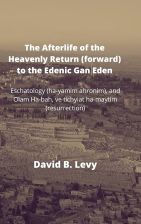
The Afterlife of the Heavenly Return (forward) to the Edenic Gan Eden
David's book on the afterlife traces the rabbinic reception history of the afterlife in Maimonides. Although the book contains further descriptions of the soul in the heavenly temple and its journey to ascend to chamber to chamber where it will be refreshed and delighted by angelic wisdom on topics such as: 1) the beauty of shabbas, 2) the unity of God, 3) proving revelation (offenbarung) before the tribunal of reason, 4) and what is virtue (arete), 5) Elijah the prophet reconciling contradictions between the Bible and Talmudim to the shining names in Gan Eden. The book focusses on Maimonides reception history hilchot teshuva that in olam ha ba there is no eating, drinking, or anything physical but tzadikim sit with crowns on their heads enjoy basking in ziv shekhinah whereby crowns are proportional in merit of Hokmah, binah, vedaat (including scientific knowledge) gained or achieved as intellectual merit (Arete) in olam hazeh. While Rambam is not the only view position on the Afterlife, as Hasidim often take literally the feast of leviathan. Ibn Ezra explains anything that takes place below in olam ha zehn is echoed pleromatically fuen die himmel fern garten memalah ie microcosm is an echo of macrocosm. Just as there is a beit din mematah (below) there is a beit din memalah (above) mirrored in a merkavah mematah and a merkavah memalah, and a beit hamikdash memalah and a beit ha mikdash metah, mayim tahtonim echo mayim eloyonim, etc. The intro cites biblical mikorot mentioned in rambam’s ma amar al tihiyat Hamaytim etc. The book focuses on maimonidean reception history. For example rambam says the pusek "the lamb will dwell with the wolf" means Jews (the lambs) will not be persecuted by anti semites (wolves) vs. the mikablim like the Ramban to Rav Kook hold there will be a "change in nature" of open miracles whereby wolves will not be carnivores. Rav Kook predicted the rise in vegetarianism as a kind of "spiritual cleansing" that will proceed the rebuilding of the beit hamikdash. The book even cites the recent text of Kafka's Vor or Dem Gezets, as a hint to the afterlife whereby the soul must receive permission from gatekeepers to proceed to the next chamber where it may beefreshed by celestial angelic discourses for instance on the beauty of shabbos, die einzigkeit des Gottes (unity of G-d), Die Tugende (virtue), etc.[17] delighted and r

A more recent book published by Dr. Levy is on the topic of King David. Although King David was a warrior and military leader, this book steers away from that “crusader” often Christological model and paints a portrait of King David as a faithful dedicated servant of the Rabbinic Sanhedrin, while it does show via the neveim that David still represents also the hoped for messianic eschatological scion. The book not only highlights key moments in David's life such as his shepherding his father Yishai's flocks making training him as a prerequisite to shepherd the people of Israel later, David's being chosen out of left field and anointing by the prophet Shmuel who looks through David's beautiful eyes, as the windows of the soul to glimpse an elevated neshama. David's slaying of Goliath against all odds proclaiming while you come before me with sword, spear, and javelin, but i come before you in the name of the “L-rd of hosts"
The Shoah as a Manifestation of Radical Evil

The Bibliography of the Shoah Includes exhaustive bibliography in 3 vols of all subject headings classified in RAMBI of the SHOAH plus books. Preceded by a long monograph on the Shoah and its uniqueness.
Dimensions of the Beit HaMikdash
in the future when the 3rd temple will be rebuilt levites and kohanim will again serve in 24 rotations 2x per year (12 x2) to serve in the Temple. The going up to serve in the Temple is known in the Talmud and antiquity as the ma'amadot. In each weekly serving of the priests the hallah would go from a marble table to a gold table to illustrate the principle of elevating in holiness. The mishna in tamid describes how even in the small towns of Israel (kefarot) processions of priestly families proceeded with the accompaniment of music and tinsell in the horns of animals as the families went up to Jerusalem.
The Art of the Book Review III
The Art of the Book Review is a 6 Volume Set that includes essays on love of book and text culture. David has published over 2,600 book reviews and offers a meditation on the art of the book review types drawing on texts as diverse as Pirkei Avot, the Confucian analects, and philosophers of education from Plato to Maimonides to John Dewey and Piaget. This six vol set titled the art of the book review has unexpected essays such as monographs on love of text referencing many religious traditions devotion to oral and written teachings. For example david cites, Rav Yehudah HaLevi who remarked my pen is my harp and my manuscripts my garden or the Vilna Gaon who wrote, "just as my feet allow me to walk in this world my books allow me to walk in higher worlds still and beyond in the seven heavens."
Topics in Judaica Librarianship
Another work, Topics in Judaica Librarianship, offers chapters on methods, strategies, and the importance of Jewish genealogical research; censorship of Rambam's Sefer Hamadah and sefer Morah Nevukhim; the Making of the Jewish Encyclopedia and Encyclopedia Judaica, and Encyclopedia Talmudit; Rabbinic reverance, love, and cherishing of texts as people of the BookS; Ethics, Politics, Hermeneutics, and Theologies of Hebraica Translations; Reel Librarians: The image and stereotypes of the librarian and Jewish librarian in Film, TV, and literature.
Censorship, External and Internal of Hebraica and Judaica
David's work on censorship of Hebraica has been noted as making a positive contribution to the field of Jewish Studies and Library Sciences[15]. This presentation examines four types of censorship of Hebraica and Judaica. Namely (1) Ancient Roman governmental censorship from the book of Macabees to illustrative sugyot (passages) in the Talmud including Ta’anit, Avodah Zarah, & Sanhedrin (2) Church1 , particularly Roman Catholic,2 censorship3 in Italy,4 from the early middle ages on that manifested itself in the confisgation, censoring, and burning5 of sacred Rabbinic texts,6 (3) Government censorship from the fascist Nazis in Germany and the Arrow Cross in Hungary to the extreme left Communists in Russia and elsewhere. The following link includes the slides present association of Jewish Libraries in 2023 [1]. The following link includes text demonstrating David's citation of over 180 footnotes [2]. https://jewishlibraries.org/wp-content/uploads/2024/07/LevySlides2023.pdf
History of the Synagogue Bibliography
One book, History of the Synagogue, is an extensive bibliography with overview essay on the history of the synagogue from the 2nd temple times, tannaitic, amoraic, geonic, savoreyim, rishonim, and ahronim periods featuring the geographical and cultural diversity of many different kinds of synagogues and their Jewish art or lack of jewish art influenced by lo oseh likhah pesel. From the Dura Europus synagogue mosaic, the Tzipori synagogue mosaic, to the medieval and Renaissance synagogues to the Hasidid wooden shtiebelak of Eastern Europe to modern trends in the history of American synagogue demographics this broad multifaceted essay is sure to touch upon many different types of jews and their prayer and learning holy spaces.
Divrei Torah
David's devar torah's on all 52 parshayot or weekly torah readings across the weeks of the year along with commentaries on the megillot (Song of Songs read on Pesah, Koheleth read on Succot, Esther read on Purim, Eicha read on Tish b'av , Yonah read on Yom Kippur as the maftir) along with the prophetic readings an Rosh Hodesh chantings, etc




The Ten Commandments
The book on the 10 commandments offers rabbinic commentary to illuminate the "big ten mitzvoth" which david shows are better viewed within the context of all 613 mitzvoth known as the TARYAG as Rabbi Simli notes when he commented that all 10 commandmentrs include implicitly all 613 commandments that flow from the roots of the ten. Rabbi Simli justifies this by reasoning that all 364 days of the year (364 corresponding to the positive commandments) one should perform with all their 248 limbs or parts of the body (248 being the number of negative commandments) so that during the year of 364 days all limbs of the body fulfill the TARYAG ha mitrzvoth. Interestingly the gematria or numerical equivalent of of the word Ruth is 606 and when 606 is added to 7 (the 7 noahide laws) the total is 613 or the number of commandments. In fact there are more than 613 commandments for instance chanukah is # 614 while for Emil Fackenheim the 614th commandment is to give to the nazis no post-humous victories.

Bibliography of Woman in the Bible, Midrash, Jewish, History, and Jewish Law
The bibliography of Jewish women treats jewish women in halakhah, the bible, midrash, jewish history, and Jewish law and any and all matters particularly relating to jewish women. Women's mitzvoth include in traditional judiasm, but are not limitted to challah making (hafrashat hallah), lighting shabbos candles, and family purity matters (the mikvah). David brings rabbinic interpretation and commentary on these mitzvoth. David brings various commentaries on Proverbs 31 showing how each biblical verse refers to a specific biblical women to the Malbim's abstract interpretaion that mishlei 31 represents women's practical virtues. David also includes essays on how technology can be misogynistic and how the modern online environment can discriminate against women.
Religious Zionism with Extensive Bibliography
David's book titled religious zionism not only offers a thorough bibliography on the subject but serves to combat the miss information that slanders, libels, and defames Israel in the name of Anti-Zionism which Phyllis Chesler calls the New Antisemtiism. The book includes introductory essays on the diversity of Ziionism in general and Religious Zionisms in particular. In addition relevant essays on ISrael's right to defend itself based on halakhic sources is provided along with a Religious Zionism power point featuring the thought of thinkers and activists like: Rabbi Yehudah Alkalai, Rabbi Zvi Hirsch Kalischer, Rabbi Shmuel Mohliver, Rabbi Yaakov Reines, Rabbi Yehiel Michael Pines, Rabbi Samuel Chaim Landau, Rabbi Abraham Isaaac Kook, Rabbi Isaac HaLevi HErzog, Rabbi Meir Bar Ilan, Rav J.B. Soloveitchik, etc. An essay from the persepctive of linguistic history is also offered on "hebrew the old-new eternal language along with a historical essayh on the Israeli ?National Anthem HaTikvah. David Has published many essays elsewhere that serve to combat and resist miss information about Israel and show a more truthful representation of the facts at:

Bibliography of History of Anti semitism and Anti Judaism
In his book on anti Judaism, David includes essays on different forms of anti semitism across millenium, such as ancient Judeophobia, cultural anti-semitism, religious Jew hatred, economic anti semitism,racial anti semitism, political anti semitism, and conspiracy theories that scapegoat jews, and anti Zionism.

Some Early Writings by David B. Levy in the Whole Gamut of Jewish Studies
Table contents of vol 1,2 show a great breadth and diversity of a broad scope of exploratory essays in the fields of jewish studies such as Biblical Exegesis, Jewish Philosophy, Jewish History, Hebrew Linguistics, Rabbinics, Jewish Literature, etc. As the table of contents in volumes 1 and 2 shown alongside the whole gamut of Jewish studies is treated by david's research that is broad, diverse, multi-faceted, and inter disciplinary. Volume 1 even includes a translation david did of an article in German from an academic German Jewish studies journal. The essay on Bialik david gave while in Tel Aviv to the archivist librarian of the Bialik Museum. The librarian said they had never encountered Bialiks work compared with the larger world literature poetic streams in England such as the Lake poets, Byran, Shelley, Wordsworth, Keats and the French Romantic tradition of Lamartine (Le Lac) and the German Storm und Drunk movement. Another unique essay by david is his article titled Der Temple which is a sustained narrative of about 10 pages in coherent fluent German.. There is also a translation by david of an article Beitrage Zur Kulturgeschichte Der Juden Bohmen's in 18 Jahrhundert.(An der Hand der zeitgenossichen Responsenliteratur von S.H. Lieben which covers Rabbi Yonathan Eibeschuts Grand Rabbi of Metz
Ethical/Halakhic Perspectives in Judaica Librarianship
Ethical/Halakhic Perspectives in Judaica Librarianship attempts to wrestle with the following questions: does the Jewish tradition have to share with regard to questions concerning netiquette and online ethics? What is the relationship between the Internet and civility? Has incivility in America increased due to social media and what are its effects on democratic public discourse? How can we measure the effects of online incivility by objective scientific criteria? Does online anonymity encourage harassment of women or does online anonymity protect marginalized groups? Why is cyberbullying a serious problem from the standpoint of Jewish ethics? How do we attempt to curb the epidemic of cyberbullying among students? How can schools and teachers take action to combat cyberbullying? What are the etiquette and ethics of social media? Does Facebook immorally lead to exploiting its users? What does Jewish law have to say about (1) responsible use of the internet? (2) causing harm psychologically to persons by "meanspeak", (3) embarrassing person in public via the internet, (4) causing harm to individuals whereby a lashon ha-rah on the internet can kill a reputation or career opportunity or shidduch as per the criteria specified by the Chofetz Chaim's laws of considering one's words that can be used as a sword to harm or used to promote life, happiness, health, and constructive good.
The Jewish Arts
The Jewish arts book includes the fine arts, music, dance, film, theater, etc. with a heavy weighting to music the most spiritual of the arts. In judaism David points out that the commandment "lo oseh lichah pesel" dont make a sculptured image was interpreted in a spectrum of commentary. For instance rabbi akiva asks a question in the mishnah if he can enjoy the waters of a roman bathhouse that have a statue of aphrodite. Rabbi akiva reasons he is not going to bow down to the statue nor did he bring it in the bathhouse so he will enjoy the waters of the bathhouse. However a few mishnayot away rabban gamliel would not handle roman coins because not only is the coin raised up as a little image in indentation on metal but worse the roman empoeror thought he was a god, with a little g like Pharoah thought he was the morning and evening star. This idolatry of the Roman emperrors who when they passed on roman eagles would be released in a ceremony and inicated idolatrously that the roman emperor had ascendended on eagles wings to the heavens.
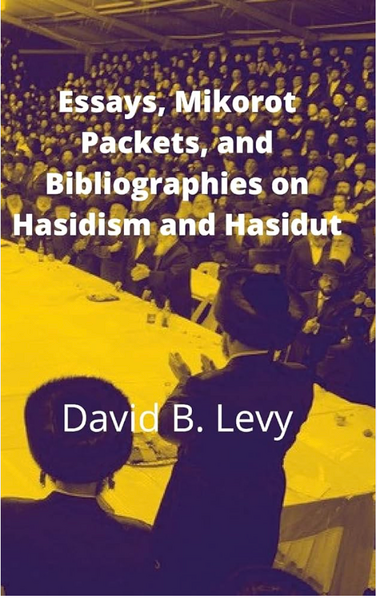
Essays, Mikorot, Packets, and Bibliographies on Hasidism and Hasidut
The book on Hasidism and Hasidut contains numerous introductory essays noting for example (1) the diversity and different types of Hasidic sects. For example Bar Ilan catalogers lists over 500 types of Hasidic groups such as Lubavitch, Satmar, Ger, Vishnitz, Burke, Alexander, etc. (2) what characterizes Hasidic groups versus the Mitnagdim, (3) the geographical areas in Eastern Europe from which Hasidic groups sprung as a grass roots movement that saw the dignity and nobility of the common Jew , (4) the chain of transmission of Hasidic dynasties such as the 7 Rebbes of Lubavith, (5) a look at the last words before ascending to the next worlds by 42 Hasidic Leaders (Tzadikim) , (6) portraits of Hasidic Tzadikim such as the Besht, Dov Ber of Metzirich, and the Noam Elimelech, and Yosef of Polonya, (7) censorship of Hasidut (the mystical publications of Hasidic thinkers), (8) the rechilut by the mitnagdim that led to persecutions of Hasidic groups and leaders including being arrested by the authorities to whom the mitnagdim tattle tailed painting the Hasidim as subversive and a danger to the state, (9) the influence of different mystical texts and streams such as Sefer HaZohar by the Rashbi, Lurianic Kabbalah, Cordovian Kabbalah Hasidic teachings etc. There are also primary documents of Hasiduth in source packets and extensive bibliographies
Rambam: Philosopher, Talmudist, and Physician
In David's book on Rambam David has chapters on Maimonides as the exemplar of torah lishma, Rambam's letter to Rabbi Yonathan HaKohen of Lunel, ha Sefer Moreh Nevukhim as a key that opens gates in shamayim, Rambam's proofs for the existence of Hashem, Rambam's ethical praxis as the Aristotelian mean as a virtue (arete) in Hilchot Deot and the Shomeneh Perkahim, Rambam's intellectual elitism, Censorship of Rambam's Guide, Rambam on ma'aseh bereshit and ma'aseh merkavah, Rambam on reconciling Science with Toreah, Leo Strauss view of the superiorit of the medieval Enlightenment of Rambma, Gersonides, and Crescas over the modern Enlightenment in Philosophie und Gesetz, Kavka's Maimonidean blind spot, Chapter of the Guide Part II, Chapter 51, and why it bas banned and censored, Maimonidean Rationalism vs. Mystical Supernaturalism identified by Schwartz, Rambam's Sefer HaMitrzvot vs. Ramban's sefer HaMitzvoth and the reconciling of divergent classification of mitzvoth by the Tashbaz, Rambam's interest on works on avodah zarah such as Nabotean Agiculture, Why Rambam rejects kishuf, Rambam on Friendship, Rambam on the Jewish calendar, Rambam's medical writings, Rambam on the psychosamatic aspect of health, Rambam's likening of ma'aseh bereshit to Scientific physics and ma'aseh merkavah to metaphysics, Rambam on Mathematifss and why Ben Zoma is still outside, Rambam the scientist and physician and the medievla scientific curriculum, Rambam on listening to music.


The Light That Does Not Leave: Religious Poetry of Friendship, Life, Loce, Authenticity, Mission and Purpose: The Revealed and Hidden Light (Ohr Nistarah)
Most recently David joint authored with rabbi Dr. Moshe pinchas weisblum a new book titled The light that does not leave: religious poetry of friendship, life, love, authenticity, mission, and purpose with long introductions, conclusions, and appendix by David. Complementing this poetic core are three significant contributions by David B. Levy:
-
A Masterful Introduction: An exploration of the literary constructs and techniques used by history's greatest poets to translate raw emotion into enduring truth.
-
The Philosophy of Friendship: A deep-dive postscript examining the nature of true friendship through the lenses of religious tradition and classical philosophy.
-
A Historical Appendix: A sweeping overview of the evolution of Hebrew poetry across the millennia—from the biblical period through the Golden Age of Spain, the tragedies of the Shoah, and into the modern Israeli era.
Levy’s analysis provides a sharp critique of modern "technological enframement" (Ge-Stell), contrasting the cold abstractions of 20th-century philosophy with the vibrant, lived experience of the Jewish calendar and the ethical imperatives of the TaRYaG Ha-Mitzvot.


What Remains
At the center of this profound volume are the eulogy poems and meditations of Rabbi Dr. Moshe Pinchas Weisblum. Written with deep empathy and spiritual clarity, these works serve as a sanctuary for those navigating the landscapes of loss, memory, and the "merits of a life well lived." Weisblum’s poetry asks the essential questions of the human journey: What is the ultimate purpose of our time on earth, and what remains after the body falters? His verses offer a rare form of consolation—one that does not shy away from the reality of morbidity but seeks to transform it into a celebration of the eternal soul.
Interdisciplinary Scholarship
Surrounding these metaphysical poems is an extensive collection of essays by Dr. David B. Levy. These essays provide a rigorous intellectual framework for the themes of the afterlife, the "End of Days," and the resurrection of the dead. Levy explores the "World to Come" (Olam Ha-Ba) from an interdisciplinary perspective, drawing from a vast array of religious, philosophical, and literary traditions. Although David has composed works mostly in English, German, and French, a Spanish translation of this work has also been made available.
Highlights of the scholarly commentary include:
-
The Final Words of Giants: A deep dive into the parting words of Jacob (Vayehi), Moses (Zot Ha-Bracha), King David, and Rabbi Yochanan ben Zakkai.
-
Mysticism and the Zohar: An examination of the Rashbi in the Idra Zutra, where the sage likens this world (Olam Ha-Zeh) to a prosdur (vestibule) and urges his disciples to prepare for the metrakalin (the celestial banquet hall).
-
The Messianic Debate: A thorough analysis of the machloket (dispute) between Maimonides (Rambam) and Nachmanides (Ramban) regarding the nature of the Messianic Age—is it a time of political peace or a period of wondrous, open miracles and a change in the laws of nature?
-
Hasidic Devotion: Accounts of the final moments and deathbed experiences of Hasidic Rebbes as recorded by Benjamin Mintz in Sefer Ha-Histalkut.
From Ancient Prophecy to Modern Parable
The book bridges the gap between ancient text and modern thought. Readers will find insights into the gematria of Light (Ohr) and its relationship to the Sabbath, the symbolism of the "Feast of Leviathan," and the representation of the next world in Y. L. Peretz’s classic Yiddish story, Bontshe the Silent. Levy even offers a striking analysis of Franz Kafka’s parable Vor dem Gesetz (Before the Law), identifying it as an unconscious memory of the Hechalot tradition regarding the angelic guardians of the seven heavens.
A Comprehensive Resource
The volume concludes with a robust Mekorot (Source Sheet), making it an invaluable tool for students and scholars. This section compiles primary sources from the Tannaim, Amoraim, Rishonim, and Achronim, including:
-
The apocalyptic visions of Daniel and Ezekiel’s "Vision of the Dry Bones."
-
The future song of Moses (Az Yashir).
-
Liturgical texts, such as the prayer for dew.
-
Philosophical citations from Maimonides’ Guide for the Perplexed and the 18th-century ethical work Orhot Tzadikim.
A Guide for the Journey
Whether you are seeking personal comfort in a time of grief, preparing a eulogy, or conducting deep theological research into Jewish eschatology, this book provides both the emotional resonance of poetry and the intellectual rigor of classical scholarship. It is a testament to the fact that while life is fleeting, the light of the soul and the truth of the Torah are eternal.


Selected Powerpoints

The PowerPoint presentations selected for this volume represent only a small portion of the hundreds developed by Dr. David B. Levy. Many originated from invitations by professors of Jewish Studies and Rabbinics, who asked Dr. Levy to demonstrate effective research methods while offering substantive insights into a wide range of biblical, historical, and religious topics. These presentations examine subjects including the Binding of Isaac (Akedat Yitzhak), King David, the Book of Jonah and the ancient city of Nineveh, and Religious Zionism, including the thought and legacy of Rabbi Abraham Isaac Kook and Rabbi Yehuda Halevi.
The volume also includes presentations delivered at academic conferences. These address genealogical research, Judaica information literacy, the library and scriptorium of the Dead Sea Scroll community at Qumran, and the history and effects of external censorship.
A third group consists of presentations that Dr. Levy volunteered to deliver remotely for public-library audiences. These accessible, interdisciplinary programs include “Music, Medicine, and Science” and “Introduction to Ethics and Online Ethics.”
Throughout these presentations, Dr. Levy draws upon both secondary scholarship and primary archival materials, reflecting the research approach discussed in his paper on reference services at LCW. The presentation on King David, for example, incorporates maps from the Da’at Mikra Atlas. The presentation on Jonah and Nineveh uses timelines, genealogies, maps, artwork, charts, and archaeological evidence to place the biblical narrative within its historical and geographical setting.
Similarly, the presentations concerning Rabbi Kook, Rabbi Yehuda Halevi, and Religious Zionism demonstrate how research can be enriched through original letters, diaries, photographs, speeches, musical scores, charts, gravestone inscriptions, and historical documents preserved in sources such as the Cairo Geniza and HebrewBooks.org. Collectively, these presentations illustrate Dr. Levy’s commitment to rigorous, multidimensional research and to making complex subjects engaging and accessible to academic and general audiences alike.
Selected Powerpoints Volume II
Spanning classical Jewish philosophy, Hebrew poetry, contemporary digital ethics, and academic librarianship, this second volume preserves eleven of Dr. Levy’s core presentations, richly illustrated with historical facsimiles, analytical slide frameworks, and primary source materials.
Included in Volume II:
Part I: Philosophy, Poetry & Manuscript Studies
-
Rabbi Yehudah Halevy: Poet, Philosopher, Physician
-
A Broad Overview of the Evolution of Jewish and Hebrew Poetry in History
-
A Presentation on Rabbi Abraham Isaac Kook
-
The Cairo Genizah & Its Scholars
-
Ezra the Scribe
Part II: Ethics, Halakha & Contemporary Issues
-
Netiquette & Halakha
-
Jewish Women, Education & Responsible Use of the Internet
-
The Politics, Ethics, Theology, and Hermeneutics of Translations
Part III: Library Science, Archives & Academic Institutions
-
The Image of the Librarian in Film, Television & Literature
-
Learning from Scholar Librarians
-
Reference Services at Touro Lander College for Women
A Crucial Resource for Scholars & Libraries Whether examining medieval Jewish thought through the poetry of Yehudah Halevy, applying classical halakhic principles to modern internet etiquette and digital ethics, or deconstructing the historical role of scholar-librarians in academic institutions, this collection serves as both an invaluable research companion and a testament to a career dedicated to organizing, preserving, and sharing human knowledge.


Volume 2 of the series ruthie wonders was on the secrets of time from many interdisciplinary perspectives such as linguistics, religion, mathematics, physics, music, anthropology, and philosophy etc. These books capture the unjaded perspective of a child who encounters phenomena with marvel, awe , and wonder.

Ruthie Wonders: The Mystique of Creation
Jointly david has been authoring childrens which his young daughter illustrates in the series Ruthie Wonders. Volume 1 of ruthie wonders was on the secrets of divine creation from the wondrous awe and marvel of a young child asking questions.
Ruthie Wonders: The Secrets of Biblical Music
This third volume of the Ruthie wonders series continues to ask questions through the unjaded innocent eyes of marvel and awe of a child. It explores the vibrant dimensions of music in the Tanakh such as as: Miriam taking the women out in song and dance after the parting of the Reed Sea, King David playing the harp to cure Saul of meloncholy, the Talmudic description of how at midnight a breeze made magical music upon King David's harp, the use of music to bring prophets to ecstasy, the sounding of the trumpets to announce Rosh Hodesh and Shabbat, the spiritual uplift and elevation of the Levitical temple choir and orchestra in the accompaniment of the Korbanot (sacrifices), to the pining lament of Jeremiah's Lamentations, chanted in the trope (cantillation) of a minor key on Tisha b’av conveying deep profound sadness for the loss of the Temple after the Hurban.
Ruthie Wonders: The Eternal Jewish Calendar
Ruthie Wonders: The Secrets of Derekh Eretz Kdmah LiTorah

Ruthie Wonders: The Secrets of Sefer Yonah
The fourth volume in the Ruthie Wonders series continues its exploration of profound Jewish concepts through the unjaded, innocent eyes of a child. Combining sophisticated scholarship with accessible, engaging prose, this book focuses on the sanctity of speech and the weight of human dignityas found in the Tanakh and rabbinic tradition.
This unique volume is enriched by magnificent, beautiful color illustrations by Ruthie Levy, whose artistic vision brings these timeless ethical lessons to life. Continuing the series’ commitment to character development, this installment bridges ancient wisdom with the modern challenges of our digital age.
What You Will Discover:
-
The Speaking Soul: An exploration of why speech is considered the divine aspect of man and how our words create—or destroy—the world around us.
-
The Weight of a Word: Key moments where speech shapes destiny, including:
-
The Sign of the Serpent: How Moses’ staff and the "leprosy of snow" served as a rebuke against the subtle "dust" of gossip.
-
The Courage of Tamar: A supreme lesson in protecting the dignity of others, even at the greatest personal cost.
-
Miriam’s Vigilance: Understanding the nuances of Loshon Ha-rah through the life of a prophetess who sought only the best for her brother.
-
-
Justice and Honor: A journey through the wisdom of the Rambam, Aristotle, and the Chofetz Chaimto discover why respecting a neighbor’s reputation is a fundamental requirement of justice.
-
The Irreversible Path: The famous "feather-pillow" allegory, illustrating why a spoken word can never be truly taken back.
-
Torah Lishma: The sweetness of learning for its own sake, transforming the human mind into a "bubbling spring" of kindness and truth.
This book serves as a vital resource for ethical character formation and a well-rounded education, exploring the "power of the tongue" as the essential tool for building a life of virtue and a world of peace

Ruthie Wonders: The Secrets of Happiness
The fifth volume in the Ruthie Wonders series continues its exploration of profound Jewish concepts through the unjaded, innocent eyes of a child. Combining sophisticated scholarship with accessible, engaging prose, this book focuses on the sacred, timeless pursuit of true fulfillment and human joy as found in the Tanakh, philosophy, and rabbinic tradition.
This unique volume is enriched by magnificent, beautiful color illustrations by Ruthie Levy, whose artistic vision brings these timeless ethical lessons to life. Continuing the series’ commitment to character development, this installment bridges ancient wisdom with the modern challenges of our digital age, offering a powerful antidote to modern anxiety and conformity.
Ruthie Wonders: The Secrets of Genealogy


When young Ruthie flips through her father's family photo albums, she sees far more than just a collection of quiet faces from generations past. She discovers a vivid, unbroken chain of faith, deep scholarship, and unparalleled courage stretching across Eastern Europe, surviving through the darkest chapters of history, and blossoming into modern-day Eretz Yisrael.
In this deeply moving sixth volume of the acclaimed Ruthie Wonders series, readers are invited to travel back in time alongside Ruthie as she explores her ancestral roots. Guided by her Abba, Ruthie explores profound questions of memory, spiritual inheritance, and the ultimate miracle of Jewish continuity.

Ruthie Wonders: The Secrets of Divine Providence and Free Will
What does it mean to choose? How do we find our own way when the Creator already sees every path before us? When young Ruthie confronts the classic rabbinic paradox of Divine foreknowledge and human free will, she looks far deeper than simple answers. She discovers a profound, timeless tapestry of moral courage, absolute accountability, and ultimate devotion stretching from the ancient altars of the Torah, through the complex philosophical debates of our greatest Sages, and into the daily choices of our lives today.
In this deeply reflective seventh volume of the acclaimed Ruthie Wonders series, readers are invited to explore the foundational pillars of Jewish thought alongside Ruthie. Guided by her Abba, Ruthie explores profound questions of selfless love, Divine providence, and the ultimate beauty of a heart that chooses goodness entirely out of its own free will.
Ruthie Wonders: The Secrets of Sefer Yonah


Can a soul ever truly escape its Divine purpose?
When young Ruthie explores the timeless narrative of Sefer Yonah (the Book of Jonah), she looks far beyond the simple story of a prophet, a storm, and a big fish. Through her vibrant, deeply intuitive artwork, Ruthie uncovers a profound, interconnected tapestry of human responsibility, Divine providence, and the radical power of repentance ( teshuvah ) that stretches from the ancient, tragic gates of Nineveh to the complex ethical realities of modern life.
In this deeply reflective eighth volume of the acclaimed Ruthie Wonders series, Ruthie and her Abba embark on a masterful intellectual and spiritual journey. Together, they grapple with the ultimate weight of ethical consciousness, the stark contrast between human virtue and mere animal instinct, and the historic transitions of Jewish life and scholarship in the Diaspora.
A Masterclass in Jewish Thought and Classical Philosophy
Volume 8 seamlessly weaves together classical Torah commentaries with the towering giants of Western and Islamic philosophy. Readers will discover how the innocent, comic-strip insights of a child's drawings open the door to advanced, multi-layered discussions featuring:
-
Classical Rabbinic Insights: Explore the psychological depths of Sefer Yonah through the commentaries of the Rambam (Maimonides), Rabbeinu Yonah's Sha'arei Teshuvah , the Vilna Gaon (The GRA), and Rav Samson Raphael Hirsch.
-
The Intersection of East and West: Dive into the philosophical dialogues of Plato and Aristotle, the political treatises of Al-Farabi and Maimonides, and the foundational social theories of Adam Smith, Karl Marx, and Sigmund Freud.
-
The Pure Pursuit of Wisdom: Contrast the contemporary, materialistic "learn-to-earn" vulgarism of modern educational institutions with the sublime, timeless beauty of Torah l'shma —learning purely for its own sake.
Inside Volume 8:
-
Ruthie's Wonderful Artwork: a beautifully detailed, 31-point exploration of Ruthie's illustrations on the Book of Jonah—complete with modern, humorous puns (like comparing ancient cuneiform tablets to modern iPads) that mask profound spiritual and metaphysical depths.
-
The Mystery of Reincarnation ( Gilgulim ): A visual and textual examination of the journey, descent, and ultimate repair ( tikkun ) of the soul ( neshama ) in this world ( olam hazeh ).
-
The Power of Memory: A touching tribute to Eastern European Jewish heritage, featuring the complete text and formatting of the classic Yiddish song Oyfn Pripetchik , passing the torch of Torah learning from generation to generation.
-
The Prophetic Conclusion: A deep dive into the historical reality of Nineveh's fleeting repentance, leading into the strongly prophecies of Nahum and the ultimate endurance of the Jewish people.
Who Is This Book For?
Through the innocent eyes of a child and the scholarly guidance of her father, Ruthie Wonders: Volume 8 invites parents, educators, and students of philosophy alike to reflect on the eternal struggle between private interest and the common good. It is an elegant, multi-disciplinary journey into the heart of Jewish thought, reminding us that no matter how deep the abyss, a soul can always return, pass the test, and choose the path of holiness.

Ruthie Wonders: The Secrets of Theodicy
Another excellent thoughtful well written work through the unjaded innocent eyes of awe and marvel of a child demanding justice by asking deep pondering questions, as questioning is the piety of thought, accompanied by insightful and sublime illustrations probing life’s deepest most elusive and difficult questions based on rabbinic sources ad fontes
Ruthie Wonders: The Secrets of Jewish Environmental Ethics


In Volume 10 of the acclaimed Ruthie Wonders series, young Ruthie embarks on an extraordinary journey through Jewish thought, environmental ethics, and animal welfare. From the ideal harmony of Gan Eden to the prophetic messianic visions of Isaiah, this volume explores what it truly means to live a life of compassion, stewardship, and spiritual refinement in the modern world.
Deeply researched yet accessible, this book examines the rich Jewish tradition surrounding eco-spirituality and vegetarianism. Readers will delve into the elevated writings of Rav Kook (A Vision of Vegetarianism and Peace), the foundational rabbinic prohibitions against cruelty to animals (tza’ar ba’alei chayim), and the rationalist philosophy of Maimonides (Moreh HaNevuchim). Along the way, Ruthie explores how early Zionist pioneers, Hasidic masters, and modern leaders have sought to heal humanity's connection to the natural world.
